Dick Proenneke: The OG Off-Gridder
Read aloud by your device. Quality depends on your browser's voices.
Off Grid In Alaska! Everyone’s Off Grid Dream
One man. One axe. One cabin built by hand on the shore of an Alaskan lake. Thirty years of solitude, and a life that still calls to anyone who has ever looked at the sky and wondered what freedom really costs.
If there’s ever been one person that has ever embodied everything there is is to love and want about off grid living, Dick Proenneke is the original off grid man.
He was fifty-one years old when he walked into the wilderness alone.
Most men, by that age, are counting down to retirement. Counting pension checks. Counting the years left on a mortgage. Dick Proenneke was counting trees. Selecting them. Felling them. Notching them by hand with tools he had forged or sharpened himself. He had come to Twin Lakes, deep in what would one day become Lake Clark National Park, to build a cabin from the land itself, and then to live in it. Not for a season. Not for a sabbatical. For the rest of his useful life.
He stayed nearly thirty years.
The Quiet Iowa Boy Who Was Built for This
Richard Louis Proenneke was born on May 4, 1916, in Primrose, Iowa, to a German immigrant family that knew the meaning of hard work the way most people know their own name. His father painted houses, drove wells, and swung a hammer for a living. His mother kept the home and the garden. The Proenneke children, seven of them, grew up close to the soil, close to the seasons, and close to the truth that nothing in life is given freely.
Dick finished primary school. He tried high school for two years and walked away. The classroom could not hold him. The fields could. He drove tractors. He fixed equipment. He took apart engines and put them back together better than he found them. As a teenager he saved up for a Harley Davidson, and even that machine, gleaming and loud, was something he wanted to understand from the inside out. He was not a man who accepted mystery. He wanted to know how a thing worked, and then he wanted to do it himself.
The Navy came calling the day after Pearl Harbor. He enlisted on December 8, 1941, and served as a carpenter through the war. He spent nearly two years at Pearl, then waited in San Francisco for orders that were slow to arrive. On a hike in the hills he caught rheumatic fever, and the illness nearly broke him. Six months in Norco Naval Hospital. A medical discharge in 1945. A young man humbled by his own body.
Something shifted in him during that long convalescence. He decided that his body would never be the weak thing again. He would tend it like a piece of fine equipment. He would keep it sharp, lean, and ready. And for the rest of his long life, he did exactly that.
Alaska Was Always Waiting
He trained as a diesel mechanic after the war and quickly became one of the best in the trade. Smart. Methodical. Patient with machines the way some men are patient with children. But the workshop was not enough. He drifted to a sheep ranch in Oregon. Then, in 1950, he made the leap that every restless soul eventually dreams of making.
He went to Alaska.
He worked on Shuyak Island. He ran heavy equipment at the Naval Air Station on Kodiak. He fished for salmon. He turned wrenches. He worked for the Fish and Wildlife Service at King Salmon. He was the man other men called when the engine would not start, when the generator died at midnight in a snowstorm, when the boat had to sail with the tide and nothing was working right. He saved his money carefully. Year after year, he built up the quiet retirement that most men spend on a house in town.
He had other plans.
The Cabin That Built Itself, Through Him
On May 21, 1968, Dick Proenneke arrived at Twin Lakes with a duffle, a film camera, a set of hand tools, and a vision so clear he could already see the cabin standing where the spruce now grew. His friends, retired Navy Captain Spike Carrithers and his wife Hope, had loaned him a cabin nearby while he worked. Babe Alsworth, the bush pilot and missionary who would become the lifeline between Dick and the outside world, would fly in periodically with mail, food, and the occasional Sears order Dick had placed for nails or a file or a pane of glass.
Everything else came from the land.
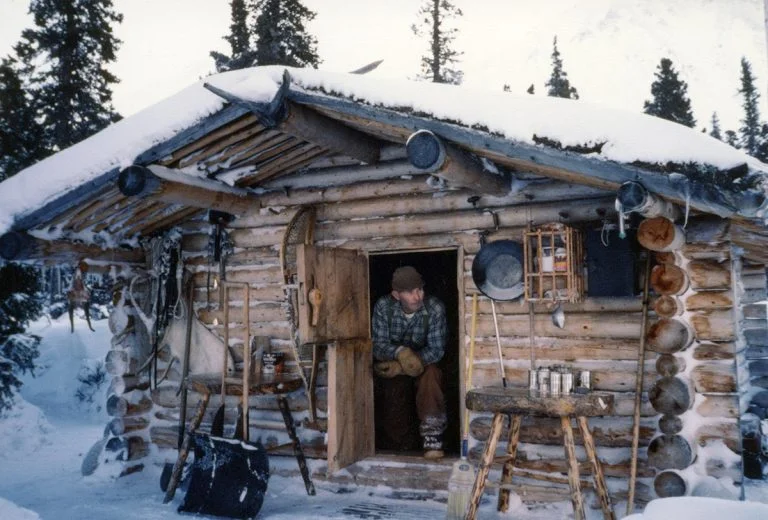
He chose the trees himself. He cut them with a chainsaw he sharpened constantly, and he hewed and notched them with hand tools that he had made or modified to fit his grip. The interlocking joinery he cut into those logs was so precise it would have shamed a master carpenter in a heated workshop. He pulled gravel from the lake bed for the cabin’s base. He gathered stones from the shore and built the fireplace and chimney by hand, mortaring each one into place with the patience of a man who knew that a good chimney has to last decades.
He cut one-gallon cans into basins, buried them below the frost line, and used the cool earth as his refrigerator. When winter froze the ground above, his stores stayed accessible through a hatch he had designed for exactly that purpose. He built a cache on stilts to keep food away from bears. He carved spoons. He shaped door hinges from scrap. He made a pair of snowshoes that would carry him across the deep powder for years. Every detail of that cabin, down to the wooden latch on the door, was the work of his own two hands.
And he filmed it. All of it. With an 8mm camera he set up on a tripod and ran himself, narrating in a quiet, plain-spoken voice that carried no boast and no theater. He simply showed the work. The notching of a log. The fitting of a beam. The slow rise of walls in the long Alaskan summer light. He thought, perhaps, that someone someday might want to see it. He had no idea he was making one of the most enduring documents of solitary craftsmanship ever recorded by a single human being.
A Life Measured in Seasons, Not Years
For the next thirty years, Dick Proenneke lived at Twin Lakes.
He hunted what he needed and no more. He fished. He gathered. He kept journals so detailed that climate scientists and naturalists would later mine them for data on weather, wildlife migration, ice-out dates, and seasonal change. He photographed the country with a careful eye. Caribou crossing the high passes. Wolves moving like smoke through the willows. The first frost on the windowpane. The northern lights bending across a black sky.
He ate well. He stayed strong. He climbed mountains in his sixties and seventies that most men in their thirties would not attempt. He chopped wood through the long winters and watched the lake freeze and thaw thirty times. He grew older, but he did not grow soft, and he did not grow bitter, and he did not grow lonely in any way he ever recorded.
He was a friend to the National Park Service when Lake Clark was established around him. He helped rangers film sensitive areas. He reported poachers. He corresponded faithfully with his brother Jake and with friends back in the lower forty-eight, his letters now collected in volumes that read like dispatches from another century. He was self-taught in everything that mattered. Naturalist. Conservationist. Writer. Photographer. Builder. Mechanic. He had no degree in any of it. He had something better. He had decades of attention.
The Quiet Drama of a Life Well Made
What makes Dick Proenneke matter, more than the cabin and more than the films, is the example.
He proved that a man could leave the noise behind. That ordinary skills, sharpened and applied with relentless patience, could build an extraordinary life. That you do not need wealth, or fame, or permission, or a perfect plan to live on your own terms. You need a clear vision of what you want. You need the willingness to work for it, alone, for as long as it takes. And you need to be the kind of person who, when something breaks, simply fixes it.
He did not retreat from the world. He stepped toward something truer. He did not run from people. He chose the company of mountains, water, weather, and his own honest labor. He did not survive in the wilderness. He thrived in it, calmly, joyfully, productively, for almost three decades.
In 1999, at the age of eighty-three, his body finally told him it was time. He left the cabin and moved to Hemet, California, to live out his final years with his brother Jake. He died on April 20, 2003, at the age of eighty-six. He willed the cabin to the National Park Service, and in 2007 it was added to the National Register of Historic Places. It still stands today, a small handmade structure on the shore of a remote Alaskan lake, visited each summer by people who fly in just to stand quietly at the door and look in.
His book, One Man’s Wilderness: An Alaskan Odyssey, edited by his friend Sam Keith from Dick’s own journals, won the National Outdoor Book Award in 1999. The documentary Alone in the Wilderness, drawn from his own film footage and narration, became a quiet phenomenon on public television and has now inspired three generations of dreamers, builders, and would-be off-gridders. More journals were published in the years that followed. The Early Years. More Readings. A Life in Full Stride. Your Life Here Is an Inspiration. Reaching the End of the Trail. Volumes of letters to his brother Jake. A museum exhibit in Donnellson, Iowa, near the town where he was born.
He left more behind, with less, than most men ever manage.
The Standard He Set
If there is an original off-gridder, an OG in every sense of the word, it is Dick Proenneke. He did not preach. He did not sell. He did not build a brand or a following. He built a cabin, and a life, and a record of both so honest and so beautifully made that the rest of us are still measuring ourselves against it half a century later.
Every person who has ever stood on a piece of raw land and dreamed of building something with their own hands owes him something. Every off-gridder who has ever cleared snow off a solar panel at dawn, hauled water uphill, split a winter’s worth of firewood, or watched the northern lights from their own front porch is walking a trail he helped cut.
He showed us that the wilderness is not an escape. It is a place where a person can finally meet themselves on equal terms. He showed us that simplicity is not poverty. It is precision. He showed us that a man with a sharp axe, a clear head, and an honest day’s work in him can make a life that the modern world, for all its noise and convenience, cannot match.
The mountain is steeper than it looks. The view, as Dick proved every day for thirty years, is better than they say.
Dick Proenneke’s cabin is part of Lake Clark National Park and Preserve in Alaska. His films, journals, and the documentary Alone in the Wilderness are still widely available. If you have not seen the footage, watch it. If you have, watch it again. There is no better off-grid education in the world.